
Performance-First Scaffolding
A powerful way to break the cycle of remediation

A combination of declining test scores along with time and financial pressures that focus interventions only on lagging skills, mean many of our students have become stuck in cycles of remediation that inhibit growth and prohibit success.
I teach English and Social Studies at a therapeutic high school with students with long histories of disrupted schooling. When I found myself teaching upperclassmen who had never written an essay, I could not justify waiting months for every component skill to develop before inviting them into meaningful academic work.
Yes, my students needed support, but they did not need to wait for every prerequisite skill to be remediated before engaging in ambitious work. So I changed from asking "What does this student need to master before they are ready to attempt this task?" to "What instruction and support would make it possible for this student to attempt the real thing now?"
Performance-First Scaffolding
I now ask students to participate in the full version of an academic task before they can complete that task independently. I then provide enough modeling, structure, feedback, and guided practice for students to participate successfully, then deliberately fades those supports as students become more independent.
In my English classroom, this might mean asking a student who has never written an analytical essay to write one. On the first attempt, I may provide an annotated model essay, a detailed rubric, a planning sheet, sentence starters, guided questions, teacher conferences, and a writing guide that identifies the job of every sentence in a body paragraph.
Performance-First Scaffolding has allowed me to maintain the same ambitious writing expectations for every student while tailoring instruction and supports to individual needs. I do not simplify the task, I use it to determine what each unique learner in my class needs to succeed.
Rarely do all my students need exactly the same thing. For example, one student may be able to make a sophisticated claim but struggle to explain how evidence proves it, while another may explain an interpretation brilliantly in conversation but have difficulty organizing it on the page. Rather than spending weeks remediating every possible weakness beforehand, a performance-first approach helps me see which supports each student actually needs.
The Performance-First Process
Step 1: Define the Destination
Performance-First Scaffolding depends on backward planning. It requires a clear picture of what students should be able to do, so that each instructional decision moves them toward that goal.
Step 2: Provide Access
Provide students with a whole (complete, challenging, and fulfilling) academic task, along with enough initial support to participate. Their performance reveals what they understand, where they struggle, and what they need next.
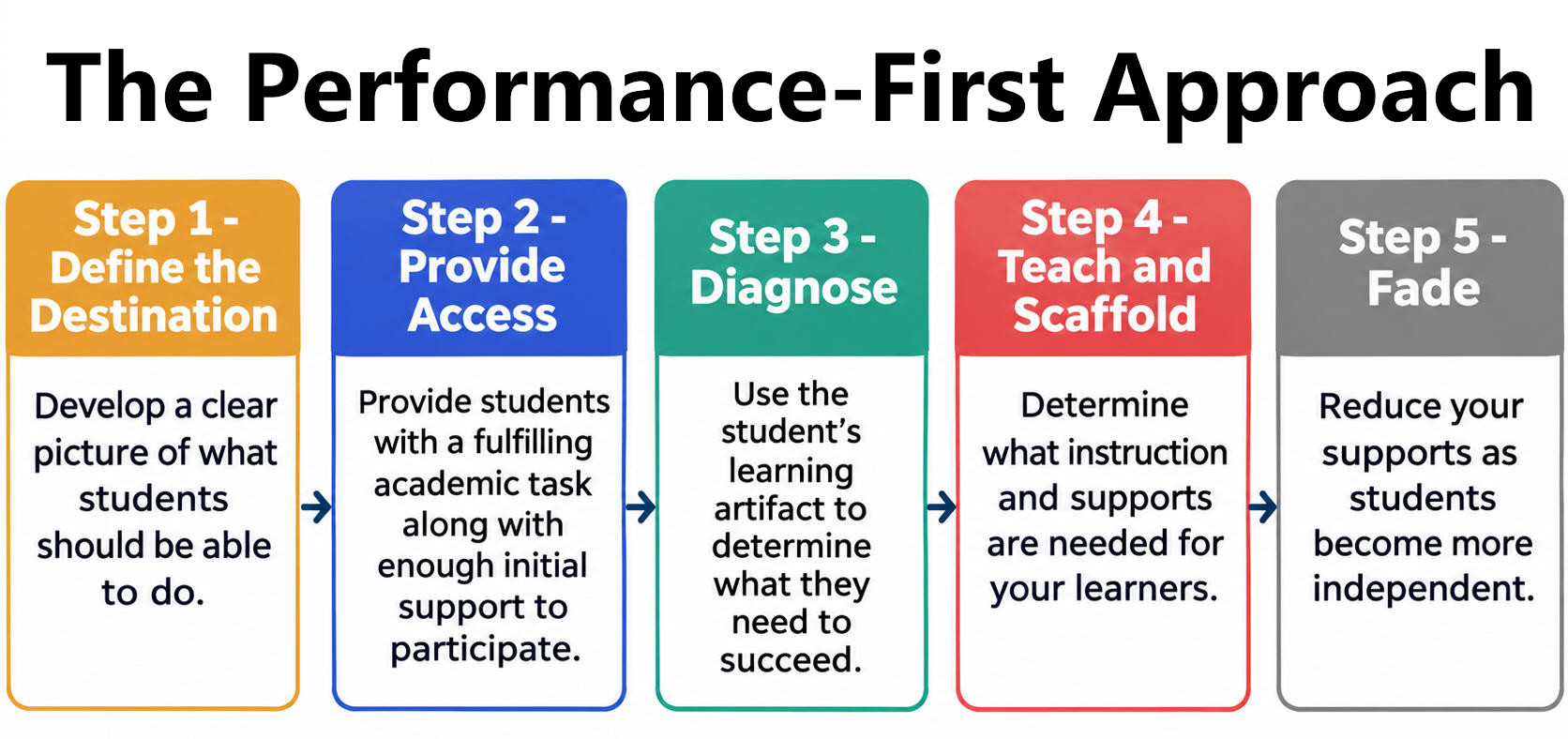
Step 3: Diagnose
A student's learning artifact from their attempt at the whole task provides some information. You need to get a fuller picture through observations of student work and discussions you have with students during the process.
Step 4: Teach and Scaffold
Once the whole task reveals where a student is struggling, determine what and where direction instruction fits. For example, if a student can select strong evidence but cannot explain how it supports a claim, I might pause for instruction on warrant writing: modeling my thinking aloud, comparing strong and weak examples, practicing together, and giving immediate feedback. I may then design a sentence frame or checklist to help the student apply that learning within the essay.
Step 5: Fade
As you provide scaffolds and direct instruction be sure to apply what you know about cognitive apprenticeship and gradual release. Reduce your supports as students become more independent. Each new attempt at the whole task, or revision of it, provides information for the next cycle.
For example, on a second essay, the model may be gone, sentence starters may become a checklist, and a sentence-by-sentence guide may become a simple outline. The task remains complex while responsibility gradually shifts toward the student.
Astounding Growth
This approach has helped my students accomplish things they believed were out of reach for them. Over the last several years, I have watched students who once saw four-year universities as out of reach enroll immediately after high school. I have watched students complete independently the kinds of work that once required extensive support or simply wasn’t attempted at all.
It's helped me to further believe in them too. My US History classes are now engaging in competitive debate and building nuanced, complex arguments about the world around them. I have designed my English class this year using an AP Literature and Composition curriculum.
Every classroom contains students who are capable of complex work they have not yet encountered, students whose records underestimate them, and students who have spent too much time being prepared for meaningful work instead of being allowed to do it. So give the task to students first. Then ask yourself, “What instruction and support would make it possible for this student to attempt the real thing now?”


 Most Read


